
Let’s face it: we’re all growing up with social media.
Have you checked Facebook Messenger or scrolled your News Feed the moment you woke up?
Watched at least one YouTube video this week?
Or got caught in the endless loop of TikTok videos?
Social media is the fastest-growing trend in human history. In fact, the rate at which social media users grow has outpaced even that of the internet itself.
To put things in perspective:
👉 In the first 10 years since the internet was born, around 1.018 billion people came online.
👉 In the first 10 years of its existence, Facebook had already surpassed 1.23 billion monthly active users.
If Facebook were a country, it would be the most populous one in the world.
And that’s just Facebook.
Many other platforms also boast staggering numbers of active users.
📊 According to [Statista], by October 2018, social networks like YouTube, Instagram, and TikTok were already attracting hundreds of millions—even billions—of active users.
We’re not just using social media anymore. We’re becoming addicted to it.
Statista also reported in 2017 that the average person spends 135 minutes a day on social media.
So yes — the opportunity for businesses here is massive.
That’s why I’ve written this step-by-step beginner’s guide to help you get started with Social Media Marketing the right way.
If you’re not using it yet, you either learn now — or risk getting left behind.
1. What is Social Media?
Before we dive into social media marketing, let’s make sure we’re on the same page about what social media actually is.
It’s one of those buzzwords that gets thrown around a lot — often used interchangeably with “social networking sites” like Facebook, LinkedIn, or Twitter.
Some people even believe that blogs aren’t part of social media.
(What do you think?)
Of course, everyone has their own opinion. But let’s go deeper and define it in a clearer, more practical way.
Wikipedia defines it as: “Social media are interactive computer-mediated technologies that facilitate the creation and sharing of information, ideas, career interests and other forms of expression via virtual communities and networks.”
In simpler terms, here’s what that means:
✅ Social media platforms are built on the internet (often Web 2.0 tech)
✅ Users participate via websites or apps (on desktop or mobile)
✅ Content is largely user-generated
✅ People interact through personal accounts (even if anonymous)
✅ Social media thrives on community
That’s a lot of techy words.
Let me break it down in plain English.
The term social media is made up of two words:
-
Social: Involves people interacting with each other, exchanging information, engaging in conversations.
-
Media: Refers to the means of communication — like TV, radio, newspapers, or the internet.
But here’s the key difference:
Most traditional media (TV, radio, newspapers) are one-way.
You consume the content, but you don’t interact back.
Social media, on the other hand, is two-way.
You create, share, comment, like, follow, repost — it’s a digital community that talks back.
👉 My Definition: Social Media = Internet-based communication tools that allow people to share content and interact with each other as a community, using personal accounts.
Is Email Considered Social Media?
That’s a great question — and one that many people wonder about.
After all, email is also based on the internet. You can reply, forward, send attachments… so is it social media?
Here’s what Anthony J. Bradley from Gartner (a leading tech research firm) explained:
🟡 Email is a distribution mechanism
🟢 Social media is a collective mechanism
In other words, email is about delivering messages.
Social media is about creating public collaboration.

Also, while email is great for one-to-one (or one-to-many) communication, it doesn’t enable public community interaction the way social media does.
That’s why we don’t classify email as a social media platform.
2. What Exactly Counts as Social Media?
If you’ve read my beginner’s guide to [Digital Marketing], you might’ve seen readers leaving thoughtful comments.
Or maybe you’ve visited a product page on an e-commerce site like Tiki and noticed something like this:
🟨 User reviews and ratings.
Surprise — those are social media features too.
Yes, really. These websites are using social media elements because they allow people to interact with content using personal accounts over the internet.
So… how do you actually know if a website or app is considered social media?
It’s simple: Look for at least one of the following features.
2.1 How to Identify a Social Media Platform
Here are some common features that signal social media functionality:
User accounts
You can create a personal profile to interact with others — this is the foundation of all social platforms.
Personal pages/profiles
Your profile usually includes a name, avatar, gender, birthday, email, phone number, etc.
News feed
A real-time stream of updates from people or pages you follow.
Notifications & personalization
You can customize your experience: what updates you receive, which content you see more often, how your profile appears.
Content posting
User-generated content is the lifeblood of social media. You can post text, images, videos, polls, or links.
Reactions & comments
Just like in real life, we express our thoughts and feelings through reactions (like ❤️ or 😂) and comments.
Share buttons
Social media enables collaboration and public reach. The “Share” button lets your content reach far beyond your own circle.
Friends, followers, hashtags, groups
These features help people connect with like-minded communities.
Ratings, reviews, polls
Many platforms use community-powered voting or review systems to reflect user opinions and experiences.
Bottom line:
If a site allows users to interact two-ways through personal accounts, it likely includes social media features — even if it’s not a traditional “social network.”
2.2 Types of Social Media (With Examples)
Social media is evolving fast — and comes in many forms.
Wikipedia listed 13 categories, while Hootsuite offered a more practical breakdown of 10 common types, each with real-world benefits for businesses.
Let’s walk through them:
1. Social Networks
Used to connect with people and brands online.
📌 Examples: Facebook, LinkedIn, Twitter
2. Media Sharing Networks
Used to discover, watch, and share photos or videos.
📌 Examples: Instagram, YouTube, TikTok, Snapchat
3. Discussion Forums
Used to ask questions, share opinions, and discuss topics.
📌 Examples: Reddit, Quora, Digg
4. Bookmarking & Content Curation Networks
Used to collect and discover content you like.
📌 Examples: Pinterest, Flipboard
5. Consumer Review Platforms
Used to rate products, services, or places based on personal experience.
📌 Examples: Yelp, TripAdvisor
6. Blogging & Publishing Platforms
Used to create and engage with long-form content.
📌 Examples: Medium, WordPress, Tumblr
7. Social Shopping Networks
Used to follow trends, discover products, and shop socially.
📌 Examples: Etsy, Fancy
8. Interest-Based Networks
Used to connect over shared hobbies or niche interests.
📌 Examples: Goodreads, Houzz, Last.fm
9. Sharing Economy Networks
Used to promote, sell, or exchange goods and services.
📌 Examples: Airbnb, Grab, TaskRabbit
10. Anonymous Social Platforms
Used to vent, share secrets, or gossip (often without usernames).
📌 Examples: Whisper, Ask.fm
Note: Social media types continue to evolve. The above list highlights the most popular forms today, but new platforms and categories emerge constantly.
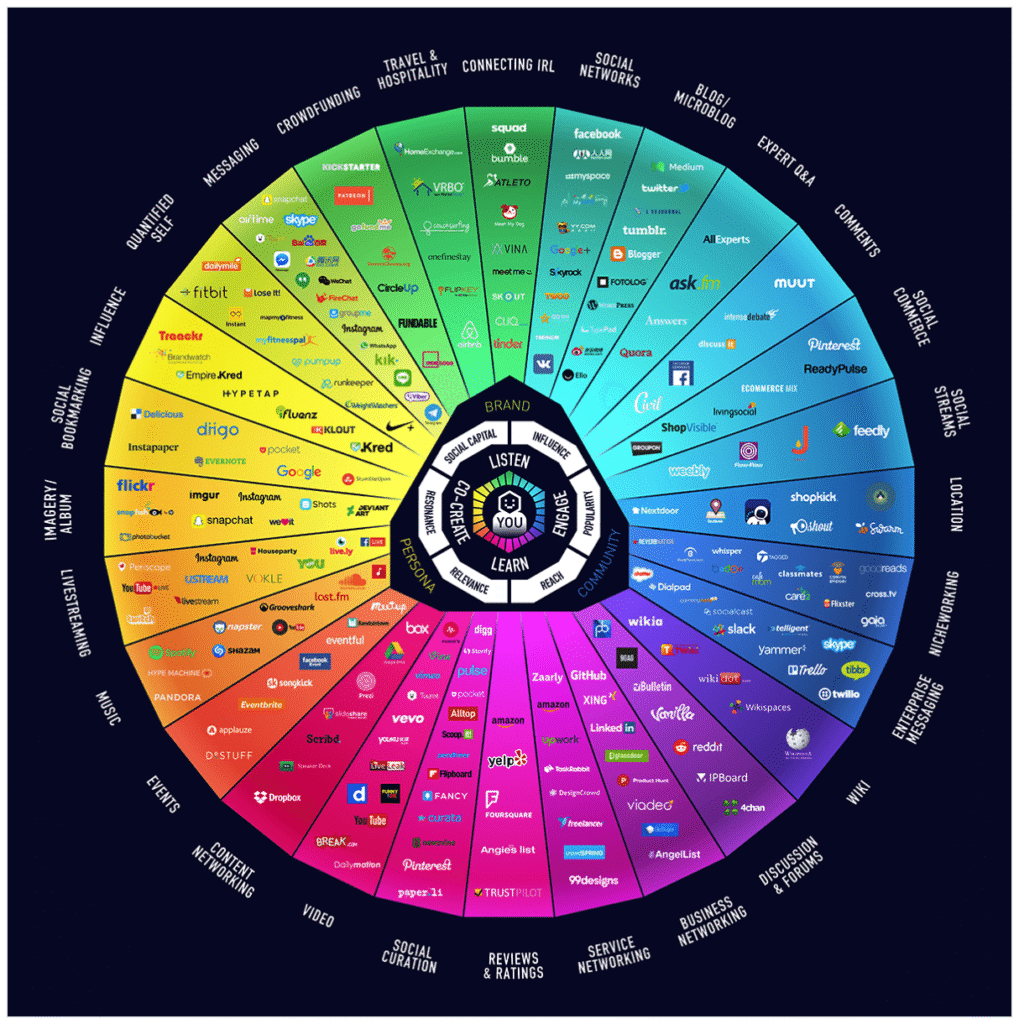
To visualize this variety, digital analyst Brian Solis created something called:
The Conversation Prism
It maps out all the categories and platforms — and is updated regularly as the landscape shifts.
Version 1.0 launched in 2008. The current version (5.0) showcases just how complex the ecosystem has become.
Before You Choose a Platform…Now that you understand what social media includes, it’s time to ask:
Which platforms actually matter for your brand, business, or content?
3. What Really Matters on Social Media?
Are you the curious type?
Before you scroll down, take a guess:
What elements do you think matter most on social media?
It’s more fun this way. If you guess right, you’ll get a small sense of satisfaction. If you don’t, no worries — at least you’re here to learn. Let’s dive in.
3.1 Content
On social media, content is the vehicle marketers use to deliver their message.
But not all content is marketing content.
In fact, most of it isn’t.
It could be a Facebook status update, an Instagram photo, a YouTube video, a Quora question, a SoundCloud track, or a product launch on ProductHunt.
👉 The point is: content on social media comes in all shapes and forms — and each platform favors different types.
So what works on one may fall flat on another.
A 10-minute YouTube video may do great — but post it on Twitter without context, and it’s gone in seconds.
A blog post with 2,000 words may bring in readers on Medium — but no one’s reading that on their Facebook feed.
Content matters —
But what matters even more?
👉 Context.
3.2 Context
Here’s something important:
The type of social platform you’re using should directly influence the type of content you create.
Let me give you an example:
I regularly publish long-form articles on my blog. They work great there.
But if I paste that entire article into a Facebook status update?
No one’s sticking around to read it.
Even more than format, you must also consider user behavior:
-
People scroll Facebook for fun
-
They visit LinkedIn for work and professional development
-
They open Instagram for inspiration and trends
Gary Vaynerchuk put it best:
“Content is king, but context is God.”
A brilliant piece of content is only brilliant when placed in the right environment — for the right people — at the right moment.
Context gives content meaning.
3.3 Engagement
Being on social media without engaging is like going to a party and standing silently in a corner.
Engagement is how people connect with each other — and with your content.
A like.
A comment.
A review.
A reply.
A mention.
These interactions may seem small, but they’re powerful signals. They tell the algorithm (and your audience) that your content matters.
Don’t just “post and ghost.”
Social media isn’t a billboard — it’s a conversation.
3.4 Sharing
Sharing deserves a spotlight of its own.
Why?
Because it’s the fuel that drives visibility.
When someone hits the “Share” button, they’re not just liking your post —
They’re saying: “Hey, I found this valuable. You should see it too.”
In many cases, it’s sharing (not likes) that helps your content go viral.
The more people share, the further your content travels — and the more new audiences you reach without spending a cent.
Social media thrives on collaboration. Sharing is how that collaboration spreads.
3.5 Hashtags
Hashtags are everywhere — and they matter more than most beginners realize.
From Twitter to TikTok, from LinkedIn to Instagram, hashtags help surface relevant content and connect users to broader conversations.
They function as labels that group content under specific topics.
You create one by placing # in front of a word or phrase (no spaces).
Hashtags can include letters, numbers, and underscores.
Example:#freelancetips or #solopreneurjourney
Using the right hashtags can help your posts get discovered by the right people — even if they don’t follow you (yet).
Now that you understand the key elements of social media — content, context, engagement, sharing, and hashtags — you’re ready to explore the next step.
4. What Is Social Media Marketing, Really?
In today’s world, if you’re a marketer — your mind naturally drifts toward social media.
But before diving into campaigns, content plans, and metrics, let’s pause for a second.
What exactly is social media marketing (SMM)?
Let’s break it down — not just with definitions, but with clarity.
4.1 Popular Definitions
You’ll find plenty of definitions floating around. Here are a few of the most cited:
“Social media marketing is the use of social media platforms and websites to promote a product or service.”
— Wikipedia
And another one:
“Social media marketing (SMM) is the use of social media websites and social networks to market a company’s products and services. It provides companies with a way to reach new customers and engage with existing ones.”
— Investopedia
Not bad. But if we’re being honest, those definitions feel… a little vague, don’t they?
They tell us what SMM is, but not how or why it works.
4.2 A More Practical Definition
Now let’s bring in a more insightful take from Neil Patel — a digital marketer who’s known for breaking things down clearly:
“Social media marketing is the process of creating content that you have tailored to the context of each individual social media platform in order to drive user engagement and sharing.”
— Neil Patel
This feels closer to the truth.
It’s not just about being present on social media — it’s about crafting content with purpose, for the platform, for your audience — in a way that sparks interaction and sharing.
Because let’s face it: If no one’s engaging with your content, you’re basically shouting into a void.
4.3 Wait… How Is It Different From Content Marketing?
This is where many people (especially beginners) get confused.
Social Media Marketing and Content Marketing overlap quite a bit — but they’re not the same thing.
In a post from Content Marketing Institute, Toby Murdock (CEO of Kapost) explains the distinction using three key points:
1. Focus of the Marketing Activity
-
In social media marketing, your content lives inside social platforms. The platform is the main playground.
-
In content marketing, your main focus is your own website — your blog, your landing pages, your downloadable assets. Social media is a channel to distribute that content, not the core of it.
2. Type of Content
-
In SMM, your content is built for the platform.
Think: short Tweets, engaging Reels, thought-provoking LinkedIn posts. -
In content marketing, you create long-form or evergreen content — blog articles, guides, email sequences, eBooks, and so on.
3. Main Objectives
-
SMM focuses on:
-
Brand awareness
-
Community engagement
-
Audience interaction
-
Customer loyalty
-
-
Content marketing is more focused on:
-
Generating demand
-
Educating your audience
-
Nurturing leads
-
Driving conversions over time
-
4.4 Why Does This Matter?
Because as a digital marketer (or a one-person business), you’ll often find yourself navigating both worlds.
The two approaches work best when they complement each other — not compete.
-
Content marketing gives you depth and ownership.
-
Social media marketing gives you reach and real-time feedback.
Understanding their unique strengths helps you make better decisions about what to create, where to post it, and why.
5. Why Use Social Media Marketing? (The Real Benefits)
If you search online, you’ll find tons of articles listing the benefits of social media marketing.
It’s not a new topic.
But since this is a complete guide for beginners, it’s worth restating — in a way that actually makes sense for someone starting out.
Here’s the truth:
We use tools because they offer value.
Social media marketing works because it brings value — both to businesses and to audiences.
So what kind of value are we talking about?
Let’s walk through the real, practical benefits of SMM — the ones that matter when you’re just getting started.
1. Boost Brand Awareness
When you consistently share content, product updates, behind-the-scenes stories, or even small wins — you start showing up on people’s radar.
You become familiar. Trusted. Recognizable.
Especially if you:
-
Use the right hashtags
-
Encourage people to tag their friends
-
Make your content easy to reshare
Every like, share, and mention is a signal.
Every tag and comment is an opportunity for someone new to discover you.
✅ Tip: Strategic timing and platform-specific content matter. With a clear plan, you can post the right content at the right moment — and get more reach with less effort.
2. Build Deeper Connections with Your Audience
Social media is a two-way street.
It’s not just about what you post — it’s about how your audience responds, engages, and relates to it.
Sometimes, it’s simple: a like, a follow, a quick comment.
Other times, it’s deeper: your story resonates, your message sticks, your brand becomes part of their world.
Here’s a great example from Vietnam:
In 2018, VinID launched a recap video called “Cảm ơn bạn đã đồng hành” (Thank You for Being with Us).
It wasn’t a product ad — it was a heartfelt tribute to their customers.
The result? A wave of positive sentiment and brand love across social media.
That’s what connection looks like.
It’s not about being perfect — it’s about being human.
3. Drive Website Traffic (and Help Your SEO)
Want more people to visit your blog, shop, or landing page?
Just start here:
-
Add your website link to your bio
-
Drop it into relevant posts
-
Guide your audience with a clear CTA (Call-to-Action)
Social media is a powerful top-of-funnel traffic source.
Even better, it helps you:
-
Build domain authority (indirectly)
-
Earn backlinks through shares
-
Get noticed by others in your niche
In short: more visibility → more visitors → more opportunities.
4. Increase Sales & Conversions
People don’t just scroll for fun — they discover, explore, and buy.
With strong visuals, engaging product demos, UGC (user-generated content), and clear offers, you can:
-
Showcase your products
-
Answer common questions
-
Create urgency and excitement
-
Build trust at every touchpoint
Done right, social media becomes more than marketing — it becomes a sales engine.
5. Show Your Company Culture (Great for Hiring)
People don’t just buy what you sell — they buy into who you are.
If you’re building a business and want to attract great talent, social media is one of the best platforms to show:
-
Your work environment
-
Your values and team spirit
-
What makes you different
📌 Example:
Vietnamese tech company VNG does this brilliantly.
Their page Life at VNG shares real behind-the-scenes stories that highlight their mission:
“All we want to do is build a home for people who share our values —
People who want to work in a place that celebrates startup culture, embraces trends, builds meaningful products, values real talent, and connects deeply as humans.
Join us if that’s what you’re looking for.”
Authentic culture attracts the right people — not just customers, but future teammates.
To Sum It Up
Social media isn’t just a marketing channel.
It’s a relationship builder, a traffic source, a brand amplifier, and yes — a sales driver.
Used with the right intention, it can support you at every stage of your business journey:
From awareness → to trust → to growth.
6. A Practical Guide to Doing Social Media Marketing
Let’s be real for a second.
You’ve probably seen hundreds of “How to do social media marketing” articles online.
But what do you actually do most days?
-
Plan content for your Facebook page
-
Write captions and post updates
-
Reply to comments and messages
-
Upload photos to Instagram
-
Drop comments in Facebook groups
-
Run ads on Facebook, Instagram, maybe Zalo…
Yeah. Sound familiar?
Almost everyone’s doing the same thing.
But why do some businesses succeed, while others struggle?
Here’s the truth: Most people are just “present” on social media — but they’re not actually doing real marketing.
If you want real results — whether it’s brand awareness or sales — you need a proper strategy. One that fits your business, audience, and goals.
Let’s break it down into a few clear, actionable steps.
6.1 Set Clear Social Media Goals
If you don’t have a goal, how will you know if what you’re doing is working?
Social media goals vary depending on your business, industry, platform, and stage of growth. But the most common ones include:
-
Growing brand awareness
-
Building community engagement
-
Driving traffic to your website
No matter your big-picture vision, having specific, measurable goals will help you stay focused and track progress.
📌 Use the SMART Framework for setting your goals:
-
Specific – Be clear about what you’re targeting
-
Measurable – Define how success is tracked
-
Achievable – Make it realistic
-
Relevant – Make sure it aligns with your bigger plan
-
Time-bound – Set a deadline
✅ Example:
“My goal is to grow my personal Facebook following from 1,500 to 2,000 within 90 days.”
Let’s check that against SMART:
-
S: Focused on Facebook followers
-
M: Measurable by 500 new followers
-
A: Based on past performance and engagement spikes, this seems doable
-
R: Growing my personal brand supports my overall content strategy
-
T: The goal has a 90-day deadline
See how that works?
6.2 Understand Your Audience
On social media, understanding your audience is everything.
It’s how you speak their language. It’s how your content resonates.
Even if you’re posting great content — if it’s not reaching or engaging your ideal people, it’s just noise.
Knowing your target audience helps you:
-
Choose the right platforms
-
Share the right content
-
Connect at the right time
-
Send the right message
Most platforms offer basic analytics tools — like Facebook Audience Insights — to help you learn about your followers.
But if you’re just getting started, don’t overcomplicate it.
Use the simple 5W1H framework to clarify who you’re speaking to:
✅ Who are they?
Demographics: job title, age, gender, location, income…
✅ What are they interested in that you can offer?
Think: educational content, entertainment, product updates, case studies…
✅ Where do they hang out online?
Facebook? Instagram? TikTok? YouTube? LinkedIn?
✅ When do they typically search or consume this type of content?
Weekends? Morning scrolls? Lunch breaks? Before bed?
✅ Why do they consume it?
To learn something? To solve a problem? To feel inspired?
✅ How do they consume it?
Do they read blog posts? Watch videos? Scroll social feeds?
Once you answer those questions, you’ll be miles ahead of the average social media marketer.
You’ll start creating content that feels relevant, shows up at the right time, and builds connection instead of noise.
6.3 Choose the Right Social Media Platforms
Now that you’ve defined your goals and identified your audience, it’s time to pick the right platform(s) to focus on.
There are dozens of social media platforms out there. But unless you have an unlimited budget and a full-time team, you simply can’t be everywhere.
That said — both you and your customers are likely using more than one platform daily. So the key is this:
Find out where your audience already hangs out and start building your presence there.
But don’t treat every platform the same.
Each one has its own algorithms, culture, and expectations. People use different platforms for different reasons.
-
LinkedIn is best for B2B and professional content
-
Facebook & Instagram are more casual, better for B2C brands
-
TikTok skews younger and thrives on trends
-
YouTube is ideal for longer-form, educational, or visual content
👉 Pick 1–2 platforms that make the most sense for your audience and start there. Focus beats overwhelm.
6.4 Create and Share Valuable Content
Valuable content builds trust. It sparks engagement. And over time, it creates community.
But here’s the mistake most people make:
They post random stuff that has nothing to do with their brand.
Funny memes. Viral videos. Personal rants.
Sure, they might get likes — but do they move your business forward?
If your audience remembers the video… but not your brand — it’s not working.
Instead, share content that either:
-
Connects with your brand’s identity, or
-
Offers something useful or relevant to your audience
For example: If you sell cosmetics, you might post beauty tips, skincare routines, and makeup tutorials — not random pet videos or politics.
And remember: People don’t want to be sold to all the time. But they do want to connect.
Here are a few post types that work well:
-
Customer testimonials
-
Behind-the-scenes moments
-
Educational tips or hacks
-
Product spotlights
-
Humor or relatable memes
-
Mini games, polls, or questions
-
Team culture or recruitment stories
And don’t forget to engage back when people comment or message you. Connection is a two-way street.
Timing matters too. Posting when your audience is active boosts your reach.
Use analytics tools or just test and observe what times work best.
Lastly, consistency wins. Not constant posting — just consistent messaging and tone.
6.5 Measure What Matters
Let’s be honest:
Many businesses don’t know whether their social media is really working.
And that’s usually because… they’re not tracking the right things (or anything at all).
You can’t improve what you don’t measure.
But — not all data is useful.
Measuring the wrong metrics (or too many) can be distracting or misleading.
Instead, ask yourself:
-
What do I want to improve?
-
What numbers actually reflect that?
-
How often will I track them?
Here are a few meaningful metrics to consider:
-
Follower growth (but quality > quantity!)
-
Engagement rate (likes, comments, shares per post)
-
Website clicks from social platforms
-
Conversion rate from social posts or ads
-
Reach & impressions of content
-
Response time to customer messages
Tools like Facebook Insights, Instagram Analytics, and even Google Analytics can help. Learn to use them. It’s worth it.
Because ultimately: Data helps you decide what to keep doing, what to change, and where to spend your time or money next.
7. Popular Social Media Platforms for Marketing in Vietnam
There are countless social media platforms out there, each serving different purposes.
But if you’re doing business in Vietnam, there are six key platforms you should pay attention to:
Facebook, YouTube, LinkedIn, Instagram, Zalo, and TikTok.
Let’s walk through each of them — so you can decide where to focus your efforts.
7.1 Facebook
With over 2.32 billion monthly active users globally, Facebook remains the largest social media network in the world.
And in Vietnam? It’s massive — estimates show around 50–60 million active users per month.
-
More than 65 million businesses use Facebook Pages
-
Over 6 million advertisers actively promote on the platform
What makes Facebook powerful is the content flexibility — from text and images to videos, livestreams, and Stories. The more variety you use, the more likely you are to stay on top of your audience’s mind.
That said, Facebook’s algorithm prioritizes meaningful interactions — especially between friends and family. This has made it more challenging for brands to get organic reach.
But here’s the opportunity: Content that sparks engagement (comments, shares) gets amplified.
So instead of worrying, create content worth sharing — and Facebook will reward you.
📢 Facebook Ads also offer incredibly detailed targeting:
You can reach people by demographics, interests, devices, behavior, and more.
In a test by HubSpot:
-
Messenger broadcasts had an 80% open rate and 13% click-through
-
Compared to email: 33% open, 2.1% click
That’s why learning how to use Facebook Messenger and chatbots can be a game-changer. The earlier you start, the bigger the benefit.
7.2 YouTube
YouTube is the video platform — and it’s not just for entertainment.
With over 1.9 billion logged-in users per month, people watch over 1 billion hours of content every single day.
YouTube is also the second-largest search engine in the world, right after Google.
Searches starting with “how to…” have been increasing by 70% year-over-year.
Want your brand to get discovered? Start a YouTube channel. Upload tutorials, behind-the-scenes, case studies — anything that adds value and fits your niche.
Plus, YouTube Ads allow you to only pay when someone watches or interacts, making it a cost-effective way to reach your audience.
And if you want to go further, YouTube SEO is your next step. The right keywords and video optimization can make a huge difference in visibility.
7.3 LinkedIn
LinkedIn is the go-to platform for professionals.
It’s where people build their personal brands, network with others, and showcase their expertise.
Unlike other platforms, LinkedIn profiles are structured like resumes — highlighting:
-
Work experience
-
Education
-
Skills
-
Certifications
-
Volunteer work
-
Awards, and more
If you’re in B2B or hiring, LinkedIn is a must.
It’s a place to establish thought leadership and attract top talent.
You can:
-
Publish articles
-
Join and engage in groups
-
Connect with industry leaders
-
Run job or brand awareness ads
-
Showcase company culture and insights
Bottom line: LinkedIn is more than a digital resume. It’s where modern professionals go to connect and grow.
7.4 Instagram
Instagram is a visual-first platform — perfect for lifestyle, beauty, travel, and any brand that can tell a story through imagery.
It supports:
-
Photo posts
-
Short videos
-
Reels
-
Stories
-
Livestreams
-
Carousels
And with IGTV, launched in 2018, you can upload vertical videos up to 60 minutes long, designed specifically for mobile viewing.
Business profiles on Instagram unlock analytics, ads, and contact features.
Well-designed Instagram content — especially when paired with high-quality visuals and authentic captions — is a great way to:
-
Build brand personality
-
Showcase products or experiences
-
Run interactive stories or polls
-
Use influencers for expanded reach
Want to go further?
Use Instagram Ads to promote directly in people’s feeds, Stories, or Explore tab — especially effective if you already have visual content.
7.5 TikTok
TikTok (known as Douyin in China) is a short-form video and music-sharing platform that launched in September 2016.
It allows users to create 15-second videos with music, special effects, filters, and transitions — all designed to capture attention quickly and visually. It’s fun, addictive, and visually dynamic.
Back in 2018, TikTok surged past Instagram, YouTube, and Snapchat to become the #1 free app on the App Store.
By June 2018, it had already hit:
-
150 million daily active users
-
500 million monthly active users globally
-
And 45.8 million downloads in Q1 of 2018 — making it the most downloaded app worldwide at the time.
🚀 Those numbers are huge, especially for such a young platform.
From a marketing perspective, TikTok is still evolving — but it already offers a native ads platform with growing capabilities.
Think of it as the early days of Facebook Ads. The sooner you understand it, the better your competitive edge.
Frequently Asked Questions (FAQ) about Social Media Marketing
What is Social Media?
Social media refers to internet-based platforms that allow users to create, share, and engage with content while connecting in communities.
It’s not just about broadcasting — it’s about conversations.
What are the main types of social media?
There are 10 major categories of social media platforms:
-
Social Networks (e.g., Facebook, LinkedIn)
-
Media Sharing Networks (e.g., Instagram, YouTube)
-
Discussion Forums (e.g., Reddit, Quora)
-
Bookmarking & Content Curation (e.g., Pinterest, Flipboard)
-
Consumer Review Networks (e.g., Yelp, TripAdvisor)
-
Blogging & Publishing Platforms (e.g., Medium, Substack)
-
Social Shopping Networks (e.g., Etsy, Depop)
-
Interest-Based Networks (e.g., Goodreads, Behance)
-
Sharing Economy Networks (e.g., Airbnb, Uber)
-
Anonymous Social Platforms (e.g., Whisper, 4chan)
What is Social Media Marketing?
Social Media Marketing (SMM) is the process of creating and distributing content tailored for specific platforms — to drive user engagement, grow visibility, and connect with your audience in meaningful ways.
In short:
It’s not about being everywhere.
It’s about being where your audience is — and showing up with value.
Final Thoughts: Your Strategy Matters More Than Ever
Social media is evolving faster than ever.
New platforms emerge, new algorithms shift visibility, and new trends go viral overnight.
TikTok is just one example of how fast things can change.
That’s why businesses must stay flexible, observant, and ready to adapt.
To succeed with social media marketing, start with the basics:
-
Clear marketing goals
-
A deep understanding of your audience
-
Choosing the right platform(s)
-
Posting valuable content at the right time
And most importantly, remember: The context of each platform shapes the content that performs best.
In the coming years, paid advertising will become more expensive as competition grows and algorithms increasingly favor ads.
But don’t fear the rising CPMs. Like any game, some will lose — and some will learn to win.
The key is knowing how to play smart, especially on the platform that matters most to your audience — in many cases, that’s still Facebook.
So, here’s the real question:
Which platform are you using right now?
And what’s your daily strategy to make it work for you?
Next step: Explore Digital Advertising.
[…] social media platforms that can change their algorithm tomorrow or suspend your account next week, email is your […]
[…] Next step: Social Media […]