
Email marketing outdated and fading into irrelevance?
These days, everyone’s talking about Facebook, YouTube, and TikTok.
They’re fun, trendy, and incredibly interactive.
So… what about email?
At first glance, email seems less exciting.
But here’s the thing:
In Vietnam, the average email open rate is 25.41%, and the click-through rate is 3.24%.
Those aren’t bad numbers — in fact, they’re on par or better than many countries worldwide, according to GetResponse’s report.
Still, let’s be honest.
When compared to Facebook Messenger or chatbots, email takes a hit — those platforms often boast higher open and click-through rates.
So does this mean email marketing is dead?
Not quite.
Even back in 2018, marketers consistently ranked email as one of the most effective digital marketing channels.
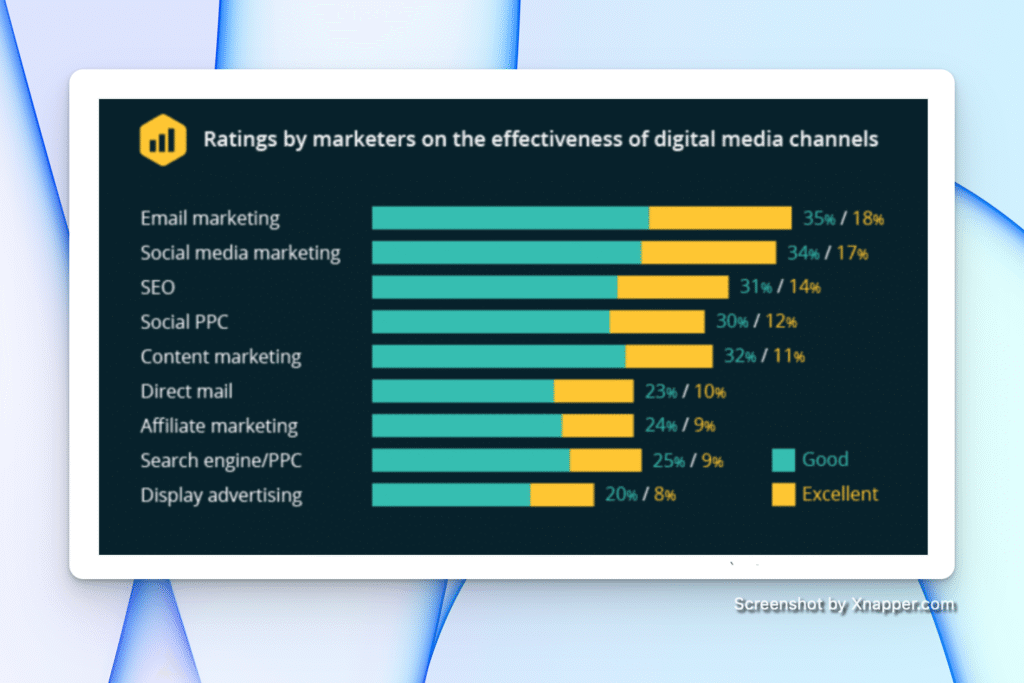
Yes — even more effective than SEO, social media, or affiliate marketing.
(Source: Smart Insights)
And let’s not forget:
You don’t need a Facebook account to survive online…
But you do need an email address — for work, for signing up, for just about anything.
That makes email universal — and indispensable.
Email marketing might not be trendy.
But it works.
The problem is: Most people don’t know how to do it right.
So I wrote this guide — a beginner-friendly walkthrough of how email marketing works, why it still matters, and how to start without messing it up.
Let’s begin with the basics.
1. What is Email Marketing?
At its core, email marketing means:
Using email to promote your products or services.
Simple, right?
But here’s a better definition:
Email marketing is the practice of using email to build relationships with potential or existing customers through relevant, value-driven communication.
Done right, it helps turn strangers into leads — and leads into loyal customers.
It’s a form of direct marketing, like traditional direct mail — but faster, cheaper, and eco-friendly (no paper, no waste).
Here’s how it works:
-
People interested in your business join your email list.
-
You send them useful content: advice, brand updates, coupons, product tips, etc.
-
Over time, you build trust — and guide them toward action.
If your email gets someone to click, reply, buy, or engage — that’s email marketing.
2. Is Email Marketing Still Effective?
You might think email marketing is old-school — especially since it’s been around for 50+ years.
But don’t let that fool you.
Here’s what the data shows:
-
In 2018, there were 3.8 billion email users globally.
-
By 2023, that number hit 4.4 billion — over half the world’s population.
📈 Email isn’t fading. It’s growing.
That same year:
-
Around 281 billion emails were sent and received every day.
-
By 2022, that rose to 347 billion/day.
(Source: Statista)
So yes — email is still deeply woven into our daily online lives.
And it’s not just about reach. It’s about results.
According to VentureBeat Insight:
-
For every $1 spent on email marketing, the average ROI is $38.
📌 OptinMonster puts that number even higher:
4400% ROI.
A joint survey by DMA and Demand Metric in 2016 showed:
-
Email marketing delivers an average ROI of 122% —
That’s 4x higher than paid search, direct mail, or social media.
Bottom line:
Email marketing still works — and works better than most people realize.
So stop underestimating it.
Let’s learn how to do it properly.
3. Why You Should Use Email Marketing (7 Key Benefits)
Here’s a truth bomb:
If you buy an email list and blast out generic messages to strangers…
You’ll likely get ignored, blocked, or marked as spam.
That’s not email marketing. That’s lazy marketing.
Real email marketing means:
-
Building your own list
-
Understanding your audience
-
Sending messages that matter to them
Done well, email is one of the best marketing channels — especially if you’re on a tight budget and want high returns.
Let’s break down the 7 key benefits of email marketing (according to Smart Insights + GetResponse):
✅ 1. More Leads
Email is a direct line to your audience.
Smart marketers use well-crafted email funnels to attract and convert leads.
✅ 2. Increased Sales
A good email sequence can:
-
Educate
-
Offer discounts
-
Promote new launches
All while gently pushing subscribers through your sales funnel — without being pushy.
✅ 3. Better Conversion Rates
According to Monetate:
-
4.24% of email visitors made a purchase
-
Compared to 2.49% from search and 0.59% from social
Email wins when it comes to turning interest into action.
✅ 4. Lower Marketing Costs
Many tools (like Mailchimp or MailerLite) offer free plans — perfect for small businesses.
Even when you pay, email has one of the lowest costs per lead of any channel.
✅ 5. Higher-Quality Leads
You can track:
-
Where someone subscribed
-
What emails they opened
-
What links they clicked
That means better segmentation — and a better understanding of who’s actually interested.
✅ 6. Integration with Other Channels
Email works even better when combined with:
-
Social media (add share buttons)
-
Facebook lead ads (build your list)
-
Blog posts (promote via newsletter)
Pro tip:
Use a signup form on your Facebook page (via Mailchimp) to turn visitors into subscribers.
✅ 7. Shorter Sales Cycles
Send the right content to the right person at the right time — and they’ll act faster.
You stay top-of-mind — and remove friction from the buying process.
4. Why Should You Do Email Marketing?
Sure, the stats look impressive — but let’s dig deeper into the real reasons email marketing matters.
These aren’t just numbers. These are the practical benefits that make email a must-have channel for solopreneurs and small businesses.
At first glance, email marketing might seem… meh.
But once you get into it, the long-term leverage becomes clear.
Let’s break it down.
4.1 Email Sends Your Message — Not the Algorithm’s
“When a new subscriber joins your list, you have a direct line to their inbox.”
— Brian Dean, Backlinko
If you had to choose between:
-
Getting one new email subscriber
-
Or one new Facebook Page follower
👉 Always go with the subscriber.
Here’s why:
A 2019 report by RivalQ revealed that organic engagement on Facebook dropped to less than 1% across all industries.
In other words, your Facebook Page fans barely see your posts anymore — unless you pay.
But when someone joins your email list, it means:
-
They want to hear from you
-
Your message lands directly in their inbox
-
You bypass the algorithm entirely
According to DMA, email is the most preferred communication channel for brand updates.
72% of people said they prefer receiving promotional content via email, compared to just 17% who prefer social media.
That’s not even close.
4.2 Email Marketing is Cost-Effective
Let’s talk numbers.
Say you use a tool like Mailchimp. For around $499/month, you can:
-
Store a list of 100,000 subscribers
-
Send up to 1.2 million emails each month
Compare that to $500 on social ads or SEO:
Can you guarantee visibility? Reach? Clicks?
Email marketing gives you:
-
A fixed cost
-
Direct targeting
-
Complete control
Plus, many email tools like MailerLite or ConvertKit offer free tiers — making this one of the most accessible channels for beginners.
4.3 Pinpoint Targeting & Easy Measurement
When someone joins your list willingly, they’re not random.
They’re people who chose to hear from you — they want your tips, your products, your insights.
This means your email list is:
-
Warmer than cold ads
-
More focused than organic social reach
And better yet — you can measure everything:
-
Open rates
-
Click-through rates
-
Conversion rates
With this data, you can tweak:
-
Design
-
Copy
-
Timing
-
Segments
Small adjustments = big results over time.
4.4 Easy Automation & Personalization
Automation isn’t just for big companies.
Even solopreneurs can:
-
Set up onboarding email flows
-
Create automated newsletters
-
Trigger offers based on behavior
With tools like ActiveCampaign, ConvertKit, or MailerLite, you can use conditions, actions, and filters to customize every step of the journey.
And personalization goes far beyond “Hi {Name}.”
Real personalization means:
-
Recommending products based on past clicks
-
Sending different emails based on interests
-
Timing delivery to when someone is most active
👉 The more relevant your message, the more likely it drives action.
5. Understand the Legal Side of Email Marketing
This is where most newbies go wrong.
They jump into email marketing — excited to send their first broadcast — but have no clue about email laws and regulations.
That’s how you end up getting flagged… or worse, fined.
Before you launch any campaign, you need to understand:
-
What’s allowed
-
What’s not
-
How to protect your brand (and your audience)
Let’s start with two of the most important global laws:
✉️ GDPR (General Data Protection Regulation)
Applies to:
📍 Anyone handling data of EU citizens
This law requires:
-
Clear consent before collecting emails
-
Easy opt-out options
-
Transparent data use
If you’re based in Vietnam but have European subscribers — you’re still affected.
✉️ CAN-SPAM Act (USA)
Signed into law in 2003, it covers:
-
Commercial email regulations
-
User rights to unsubscribe
-
Penalties for violations
Rules include:
-
Clear sender identity
-
Honest subject lines
-
Visible unsubscribe links
Most email platforms (like Mailchimp or ConvertKit) help you stay compliant — but it’s your job to understand the basics.
🇻🇳 And What About Vietnam?
In Vietnam, Decree 15/2020/NĐ-CP outlines rules and penalties for spam or unauthorized marketing emails.
Key points:
-
Sending promotional emails/messages without consent =
💸 Fines from 5M to 10M VND -
Failing to provide unsubscribe options or proper opt-out system =
💸 Fines up to 100M VND -
Spamming, malware distribution via email =
💸 Fines from 60M to 80M VND
👉 So even if you’re a small solo creator, compliance isn’t optional.
It’s about respecting your audience — and building long-term trust.
6. Understanding Email Deliverability
According to a 2015 report by Experian, 78% of companies struggle with email deliverability.
That’s huge.
Because no matter how good your email content is, it won’t matter if your subscribers never see it.
This is where most people ask the obvious:
“Why do my emails end up in spam?”
The answer lies in a fundamental distinction — and understanding it will help you protect your inbox placement.
6.1 What is Email Deliverability?
Let’s break it down:
-
Email delivery simply means your email was accepted by the receiving server.
-
Email deliverability, on the other hand, means your email actually landed in the inbox.
Your email could be delivered (technically sent), but still miss the inbox — getting lost in spam, promotions, or blocked by ISPs.
6.2 What Affects Email Deliverability?
Email deliverability boils down to three pillars:
6.2.1 Reputation
Your sender reputation is like your credit score for email. It’s built over time — and it’s a key factor ISPs use to decide if you’re trustworthy.
Here’s what they look at:
-
Relevant, properly formatted emails
→ Use clean HTML, avoid spammy words like “free” or “discount”, and write clear, honest subject lines.
→ Don’t trick your readers — misleading headers get flagged. -
Subscriber engagement metrics
→ High open and click-through rates signal trust.
→ Even small drops can damage your sender score.
🧠 Example:
Two emails — one with 200 opens out of 500 (40%), another with 500 out of 3,000 (16.7%).
Email A builds a better reputation despite fewer total opens.
-
Consistent sending volume
→ Avoid sending big batches out of nowhere.
→ Ramp up gradually with new IPs, and send consistently (e.g., weekly or monthly). -
Low complaint rates
→ Keep spam complaints below 0.1%.Two types:
-
External complaints – users hit “Mark as Spam” in Gmail, Yahoo, etc.
-
Internal complaints – users unsubscribe and report you on the confirmation page.
External ones hurt more — they affect your domain reputation directly.
-
-
Avoid spam traps
Types of spam traps:
-
Pristine traps: fake emails created only to catch spammers.
(These show up when people scrape or buy email lists — never do that.) -
Recycled traps: old emails that once belonged to real users, now reactivated to monitor spam.
🔒 How to avoid traps:
-
Never buy email lists.
-
Use double opt-in (confirmed signup).
-
Validate emails with tools like ZeroBounce.
-
Remove bounces and inactive users regularly.
-
-
Keep bounce rates low
→ Hard bounces = invalid or fake emails → permanent failure.
→ Soft bounces = temporary issues (e.g., inbox full) → retry okay.🎯 Aim for total bounce rates below 2%.
-
Avoid blacklists
If your IP or domain lands on a major blacklist, your emails can get blocked entirely.
👉 Use tools to check your status:
6.2.2 Infrastructure
Your backend setup plays a key role too.
Best practices:
-
Use dedicated IPs if you’re sending high volumes.
-
Make sure your sending domain has:
-
A valid MX record
-
No open proxies
-
-
Register for ISP feedback loops (FBLs), so you know who’s complaining.
-
Have systems to quickly remove flagged or bouncing emails.
6.2.3 Authentication
Authentication helps ISPs know your emails are legit.
There are 3 main protocols:
-
SPF (Sender Policy Framework)
Verifies if the sending server is allowed to send on behalf of your domain. -
DKIM (DomainKeys Identified Mail)
Signs your message with a cryptographic key to ensure it wasn’t tampered with. -
DMARC (Domain-based Message Authentication, Reporting, and Conformance)
Tells ISPs what to do with messages that fail SPF/DKIM checks — and gives you reporting.
💡 Good news: If you’re using providers like MailerLite, ConvertKit, or SendGrid — they walk you through all of this step-by-step.
7. Email Marketing Principles
Email marketing is not just about having a list and sending messages hoping they’ll convert.
There are important principles and best practices you need to understand and apply if you want your campaigns to succeed in the long run.
7.1 Permission First
Remember, you’re a guest in someone’s inbox.
That’s why you must always get permission before sending emails to anyone.
“Getting into someone’s inbox is like being invited to their home for dinner. If they ask you to take off your shoes, you do so out of respect.”
— Neil Patel
While it may sound like you’re the one reaching out, in reality, it’s the subscribers who opt in to be on your list.
Some people are drawn in by a freebie, others simply want helpful tips or updates. But when they sign up to receive something from you, they’ve already granted permission.
Most reputable email marketing platforms allow you to set up a confirmation email after someone submits their information.
Here’s an example:
Confirmation emails help boost subscriber engagement and ensure you’re communicating with real people — not bots or fake addresses.
And importantly, by clicking the confirmation link, the subscriber explicitly gives you permission.
7.2 Be Transparent
Set the right expectations by telling subscribers what kind of emails they’ll receive and how often you’ll send them.
A specific call-to-action or clearly explained benefit on your signup form can significantly increase opt-ins.
Here’s an example from the opt-in section of my own blog:
“Join 2,000+ solo builders learning how to grow without burnout — actionable tips delivered weekly.”
Being transparent is like making a promise — and you must honor it to build trust.
7.3 Stay Relevant
Subscribers only want to receive emails that matter to them.
If your emails aren’t relevant, they’ll ignore them, delete them, or worse — mark them as spam, which directly hurts your deliverability.
“Relevance is the secret weapon of the email marketer and the quickest path to revenue.”
— Campaign Monitor
According to Experian, emails with personalized subject lines have a 26% higher unique open rate than non-personalized ones.
To deliver relevant content, successful personalization strategies include:
• Segmentation
Not everyone joins your list for the same reason. Some are looking for beginner advice, others are ready to buy. Segmenting your list allows you to tailor your message for specific groups.
Start with basic segments like location or signup source.
Over time, refine them based on behavioral data like open rates, clicks, and conversions.
Examples:
-
Signup source segmentation
Segmenting by where the user signed up from (e.g., blog, landing page, or quiz) gives you contextual targeting. -
Contact rating segmentation
More advanced segmentation based on engagement and interaction levels.
• Dynamic Content
Every subscriber has a different context. That’s why your email content should adapt dynamically.
Sure, using someone’s first name is a good start, but modern personalization goes far beyond that.
With custom fields, you can store and use all kinds of subscriber data — from gender and birthday to past purchases or browsing behavior.
Example: Adidas uses dynamic content to display different products based on gender:
In another test, the Intercom sales team added personalized video messages to their emails and saw a 52% increase in replies.
If you’re not using personalization in 2025, you’re already behind.
According to research, 75% of businesses invested in personalization back in 2015.
• Email Automation
The beauty of email marketing is that it can be automated.
Automation helps you send timely, relevant, and personalized emails at scale, without manual effort.
Here’s an example workflow using GetResponse:
Some common automation workflows include:
-
Welcome sequences
-
Abandoned cart follow-ups
-
Re-engagement campaigns
-
Birthday or anniversary emails
The key is: Analyze your audience and build automated sequences that deliver value at the right moment.
8. How to Start with Email Marketing
So… how exactly do you begin?
A lot of beginners either overthink it or skip essential steps. But email marketing doesn’t need to be overwhelming.
Here’s a clear path to get started, the right way.
8.1 Choose the Right Email Service Provider
Your first move? Pick an email marketing platform that fits your needs.
This decision matters more than you think. Once your list starts growing, switching platforms later can be a technical mess — trust me.
The good news? Most providers today offer similar core features:
-
Email campaigns
-
Automation workflows
-
List management
-
Reporting
-
Templates
So your final choice comes down to preferences — UI, pricing, integrations, or extra tools.
Not sure where to start? Don’t worry — I’ve got you. In Chapter 10, we’ll compare the best email marketing platforms for beginners.
8.2 Grow Your Email List from Zero
An email list is not a “build it and they will come” situation.
No one joins your list just because you have one. You need to give them a reason — something valuable. This is where lead magnets come in.
A lead magnet is a freebie (guide, checklist, discount code, mini-course, etc.) that solves a specific problem — and people exchange their email for it.
Here’s what a good lead magnet looks like:
![Lead Magnet Example — Source: OptinMonster]
Once you’ve got your lead magnet ready, here’s where to learn how to actually build that list:
Yes, there’s overlap. But if you read a few of these, you’ll spot the timeless strategies that work best for your business.
8.3 Send a Great Email Sequence (Not Just Random Emails)
Letting your email list sit for months without interaction?
That’s a slow death.
You must activate your list with valuable emails from the start.
But what should you send?
It depends on your business model. Here’s a breakdown of email types based on lifecycle stages:
| Lifecycle Email | Description | Example Email Campaigns |
|---|---|---|
| Onboarding Emails | Help new users get started and experience value quickly | Welcome emails, account activation, profile setup, free trial ending |
| Subscriber Emails | Keep the conversation going with those who opted in | Blog updates, newsletters, course emails, new feature announcements |
| Promotional Emails | Drive sales, brand awareness, or engagement | Discounts, seasonal sales, product upgrades, event invites |
| Transactional Emails | Confirm or complete a user-initiated action | Order confirmations, password resets, invoices, shipping updates |
| Behavioral Emails | Triggered by user actions or milestones | Abandoned cart, recommendation, milestone emails, review requests |
To craft great sequences, you’ll also want to learn how to write emails that actually get opened and clicked:
Quick Tip: Even if you’re sending from your business name, write as if you’re a friend. This makes your emails human — and worth reading.
Need design inspiration?
Check out Really Good Emails and Email Drips for examples from top brands.
8.4 Analyze and Segment Your Audience
Email marketing without analysis is like cooking with your eyes closed.
Thankfully, most email tools give you free campaign reports with data like:
-
Open rate
-
Click-through rate
-
Bounce rate
-
Unsubscribes
-
Conversions
These numbers help you understand what your subscribers actually care about.
For example:
If open rates are low, maybe your subject lines need work.
If clicks are weak, maybe your CTA isn’t compelling.
But analysis isn’t just about fixing mistakes — it’s how you segment your list for higher conversions.
Segmentation = sending the right message to the right person at the right time.
Some ways to segment:
-
Based on location
-
Based on what lead magnet they opted into
-
Based on past purchases
-
Based on open/click activity
Once segmented, your emails become 10x more relevant — and subscribers stay longer.
9. The Most Important Email Marketing Metrics
Yes — all metrics matter.
But these 6 are the ones you should actually pay attention to when evaluating your email marketing performance.
1. Delivery Rate
This is the percentage of emails that actually land in inboxes (Primary, Promotions, Updates…) — not the spam folder.
If your delivery rate is consistently low, something’s wrong:
-
You might have issues with your sender reputation
-
Your domain may be flagged
-
Your list might have too many invalid or inactive emails
✅ Good benchmark: Aim for >95% delivery.
2. Open Rate
Open rate = % of delivered emails that are opened.
It’s one of the simplest ways to gauge how interested your subscribers are and how good your subject lines are.
Low open rate?
→ Try writing more curiosity-based or value-driven subject lines.
✅ Good benchmark: >20% open rate (varies by industry)
3. Click-Through Rate (CTR)
CTR = % of subscribers who clicked a link inside your email.
This metric tells you how well your content, design, and CTA (call-to-action) are working.
High open rate but low CTR?
→ You got their attention, but didn’t deliver value or make clicking worth it.
✅ Good benchmark: >2-4% CTR is solid.
4. Bounce Rate
Bounce rate = % of emails that did not get delivered.
There are two types:
-
Hard bounce: Invalid email address. Remove these ASAP.
-
Soft bounce: Temporary issue (full inbox, server down, etc.)
✅ Safe zone: <2% bounce rate.
5. Unsubscribe Rate
People unsubscribing doesn’t always mean you did something wrong.
But if many people leave every time you email, it could mean:
-
You’re emailing too often
-
The content isn’t relevant
-
Your subject line overpromised and underdelivered
✅ Good benchmark: Keep unsubscribe rate <0.1%
6. Conversion Rate
This is where the money is.
Conversion rate = % of subscribers who take a specific action after clicking your email.
Actions can include:
-
Buying a product
-
Signing up for a webinar
-
Downloading a freebie
-
Registering for an account
✅ Goal: Aim for >2% conversion if you’re doing list-building or sales.
📚 Further reading on email metrics:
10. Best Email Marketing Tools for Beginners
There’s no one-size-fits-all email tool.
Your perfect tool depends on your budget, your goals, and how deep you want to go with automation.
Here are my top beginner-friendly picks:
🟩 GetResponse
A solid all-in-one platform that’s beginner-friendly but powerful.
-
Interface supports Vietnamese (helpful if that’s your language)
-
Easy list management and analytics
-
Offers free 30-day trial — no credit card
-
Includes landing pages, webinars, and funnels
💰 Starts at: $15/month
👉 Recommended if you want more than just email
🟦 ActiveCampaign
The best choice if you want advanced automation without needing a tech degree.
-
Visual automation builder
-
Smart behavioral targeting
-
Great support via phone, chat, email
-
Best for growing businesses or professional creators
💰 Starts at: $9–15/month
👉 Recommended if you’re serious about long-term automation
🟨 Mailchimp
Best for total beginners or small side projects.
-
Free plan for up to 2,000 contacts and 10,000 monthly sends
-
Simple drag-and-drop builder
-
Integrates with WordPress, Shopify, Facebook, Typeform, and more
💰 Free plan available, paid starts at $9.99/month
👉 Recommended if you want to start simple and test things
Frequently Asked Questions (FAQ)
❓ What is Email Marketing, in simple terms?
Email marketing = building trust and relationships via email — then turning that trust into action (like a sale, signup, or referral).
❓ Why should I even bother with email marketing?
It’s still one of the highest-ROI channels in digital marketing.
-
You own your list (unlike social media)
-
You can personalize messages
-
It works even with a small audience
❓ Why are my emails going to spam?
Top reasons:
-
You didn’t get permission (no proper opt-in)
-
Your content has spammy words
-
Your domain or IP has poor reputation
→ Always get explicit consent, and use a trusted email provider.
❓ Which email platforms are best?
Top picks for most solo creators and marketers:
-
ConvertKit – great for creators
-
ActiveCampaign – advanced automation
-
GetResponse – all-in-one tool
-
Mailchimp – beginner-friendly
Final Thoughts: Are You Ready?
If you’ve made it this far — you already know more about email marketing than most beginners.
Yes, it’s a long post.
Yes, it can feel like a lot to take in.
But this is your edge.
Most people ignore email.
You won’t.
🔑 TL;DR Summary:
Step 1: Choose your platform (ConvertKit / ActiveCampaign / GetResponse / Mailchimp)
Step 2: Build your list with a lead magnet
Step 3: Set up a thoughtful email sequence
Step 4: Track key metrics and improve based on data
There’s no perfect formula here.
Just experiment, learn from real data, and improve your copywriting over time.
✉️ Email isn’t dead — it’s one of your most powerful marketing assets.
So…
Are you ready to start building your list?
Next step: Social Media
[…] Next step: Email Marketing […]